
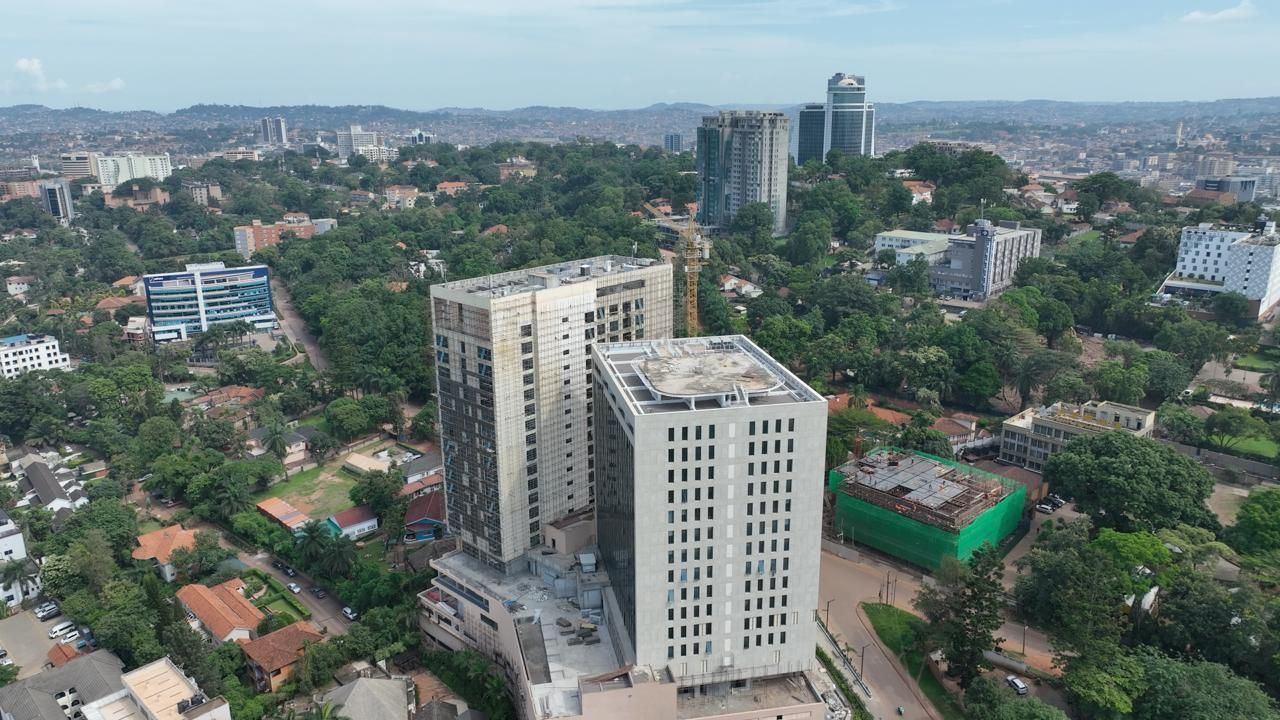
At least 2.5 working hours per day could be saved for a certain class of travellers if Kampala's emerging helipad infrastructure becomes fully operational, allowing them to escape the capital's worsening traffic congestion by opting for air mobility.
A recent World Bank-backed study indicates that on average, at least 2.5 hours are lost daily due to congestion, which is equivalent to 52 lost work hours per year, turning congestion into one of the city's most expensive hidden economic burdens.
As Kampala continues to struggle with this chronic traffic congestion, vehicle emissions and poor infrastructure, developers have shifted to designing high-end buildings with helipads, allowing helicopters to take off and land directly on top of buildings.
Monitor Publication has assessed the emerging rooftop helipad facilities, including Twed Heights in Nakasero, Kingdom Kampala Phase II, Mulago Women's Specialised Hospital, Kiruddu National Referral Hospital, Lubowa International Specialised Hospital, and Krish 360 Seven-Star Development, among others.
Twed Heights
On Lourdel Road, adjacent to Nakasero Road, and Kyadondo Road in Nakasero, an upscale Kampala City suburb, a striking 26-storey tower is rapidly transforming Kampala's skyline.
Rising above the city's commercial heart, Twed Heights, a development by TWED Property Development Ltd, with a helipad rooftop, signals Uganda's growing ambition to embrace urban infrastructure and world class real estate.
The building has a Grade A office and hospitality complex, aiming to offer over 75,670 square feet of premium office space, approximately 500 spaces in its parking bays, and 13 high-speed lifts, among other modern amenities.
Speaking about the development, Mr lan Twebaze, the chief of developments and group operations, said the infrastructure aims to enhance Kampala's mobility and connectivity by reducing the travel time lost as a result of traffic.
Mr Twebaze asserted the infrastructure incorporates a helipad, designed to international standards, targeting members of diplomatic missions, institutional occupiers, and modern urban users, aiming to promote global hospitality brands, leading to Uganda's economic growth.
"While helipad facilities do exist in select locations within Uganda and the wider region, ours represents a new generation of integrated mixed-use developments where aviation accessibility is incorporated into a broader premium business and hospitality environment," he said.
The venture is geared toward creating a favourable environment for businesses, guests, and occupants to operate in a secure, technologically-advanced environment, and positioning the city as a competitive regional investment destination.
Helipad opportunities
During a site visit by this publication, the infrastructure looked nearly complete, with the workers busy on the last phase of construction, lighting, engineering, and other grand work testing.
Mr Twebaze noted that the official opening date of the facility would be revealed later. Once open, it will improve high-level business travel and enhance strategic operations, hence complementing existing transportation infrastructure.
"Once operational, the development will support long-term job creation through hotel operations, facility management, retail, food and beverage, security, maintenance, and associated service industries," he noted.
He also projected that the development aims to foster Uganda's aviation sector through aviation logistics providers, charter operators, maintenance support services, pilot operations, emergency response coordination, and executive transport services.
For the helipad user's safety, Mr Twebaze said they have incorporated advanced fire and life safety systems, emergency response infrastructure, advanced 24/7 surveillance, and biometric access for high-security areas to ensure readiness for any emergency that may arise during the facility's use.
He added that the facility also has surveillance systems like cameras and internationally aligned engineering standards to ensure no change to any sabotage, citing that it was worked on by globally experienced consultants, engineers, and technical teams to ensure mandatory satety considerations.
"The helipad itself is being integrated within a broader operational and safety framework designed to prioritise controlled access, emergency preparedness, structural integrity, and compliance with applicable aviation and building safety requirements," Mr Twebaze explained.
Among other security features are modern monitoring and building management systems that aim to support rapid communication, incident response coordination, and operational oversight for the safety of the occupants.
He said all necessary steps have been taken to operate with different stakeholders to ensure the safety of all occupants and visitors, noting that the collaboration will extend to working with the police, medical response, and evacuation procedures, among others.
Kingdom Kampala Il Phase 2
Another emerging helipad infrastructure under construction, Kampala Il Phase 2, on Nile Avenue, adjacent to Dewinton Road, is aimed at transforming Kampala's skyline, tailored for executives and international travellers.
Mr Prabhat Mishra, the general manager of Crane Management Services Ltd, said a 21-storey tower is projected to be completed by December 2029.
It will have 70,000 square metres of built-up area, three large basement parking spaces, and a helipad to accommodate one helicopter landing on its top concurrently.
Mr Mishra said they were intrigued to include the helipad, not because people have helicopters, but due to increasing city traffic congestion, which leaves several people stuck in traffic, leading to a loss of time, which affects the economy.
"The economy is growing 7.5 percent every year, the population is growing, and we have fears in the next five years that the traffic jam in Kampala will become so tense it will be a big threat to the business people who may need to be doing urgent work," he explained.
Mr Mishra stated that the 14.5-hectare Kingdom Kampala II Phase 2 helipad is designed to facilitate timely movements of 'classy' travellers in and out of Kampala, limiting the risks of economic loss, road crashes and diseases associated with air pollution, especially fumes released by vehicles during traffic.
"Although the government is trying to put in the infrastructure, in the future, due to the increasing number of cars on the streets, the road infrastructure may not be enough," he added.
The Crane Management Services general manager noted that they are targeting both officials from the government and the private sector, who may wish to travel for a limited time to meet their commitments such as those from banks, oil companies, telecom companies, and international visitors.
Although helicopter ownership remains relatively scarce in Uganda today, Mr Mishra said the infrastructure itself could trigger future demand and accelerate private and institutional uptake of aerial transport services.
The helipad is positioned to link travellers to different destinations like Entebbe International Airport, Kololo airstrip, and upcountry, boosting the economy, health, and tourism sectors. The building has 14 floors, 42,000 square metres of build-up area, and parking for about 400 cars.
Kiruddu Hospital helipad
During a site visit at Kiruddu National Referral Hospital, Mr Baker Mubiru, the hospital's public relations officer, told this publication: "Despite instituting and testing the helipad at the hospital's rooftop, we have never received any patients through the skies!
Being a national referral hospital handling burns and some emergency surgeries, and as Uganda awaits the start of its commercial oil production by the end of the year, Mr Mubiru underscored the urgent need to operationalise the use of the helipad, projecting that the number of burn cases may increase due to the ettects.
"Many countries that extract oil experience a lot of challenges in burns; we may need a fully functional helipad to airlift patients in case of emergencies to avoid losing lives to supplement the ambulances," he stated.
The 200-bed capacity Kiruddu hospital in Makindye Division, Kampala, serves as one of the public tertiary facilities managed by the Ministry of Health.
Strict approval process
Mr Vianney Luggya, the spokesperson of the Uganda Civil Aviation Authority
(UCAA), acknowledged that before the construction of any helipad infrastructure, the body first conducts an assessment to avoid shortcomings in accordance with the Civil Aviation (Heliport) Regulations, 2022.
Section 6 of the Civil Aviation (Heliport) Regulations, 2022, provides that a person shall apply for a heliport construction permit to UCAA, with a detailed design of the proposed construction, including related architectural requirements for approval by the relevant authority; heliport data; and, where applicable, a topographical map of the proposed heliport site.
Mr Luggya said: "Safety measures to be followed by the private helipad operators to avoid accidents are diverse, cutting across all safety areas of operations, maintenance, planning and construction, obstacles and safety management."
The UCAA spokesperson attributed the limited number of helipads in Uganda to difficulties in meeting safety and security requirements and the costs of construction and maintenance, tasking developers to stick to the regulatory provisions.
When asked whether ordinary Ugandans are allowed to own private helicopters, Mr Luggya said it is possible but faces a tough approval process of getting an air service licence (ASL), meeting the general aviation provisions for the certification, registration, and operation of the aircraft, among others.
Building regulatory body silent
However, the National Building Review Board (NBRB) remained silent when asked about the criteria they employed as a regulator before approving helipad building plans for public safety, on the list of approved helipad building plans in Kampala, and recommendations for the effectively checked project.
In the health sector, officials said the helipads are designed to facilitate emergency evacuation of patients from rural health centres to the urban hospitals and from these urban hospitals to Entebbe International Airport if the need arises.
Mr Emmanuel Ainebyoona, the spokesperson of the Ministry of Health, underscored the relevance of helipads in boosting Uganda's health sector, noting that the ministry is promoting the establishment of air and water ambulances to supplement road ambulances for efficiency.
He said currently, the ministry has an operational helipad at Mulago Women's Specialised Hospital, International Specialised Hospital of Uganda (ISHU) at Lubowa, and Kiruddu National Referral Hospital.
"If we have a patient who needs to be evacuated by the helicopter from any location to Mulago Women's Specialised Hospital or ISHU, they will be able to land," Mr Ainebyoona said.
He added: "Other major hospitals, mainly in congested settings, will have helipad provisions as per the designs. We are looking at developing air ambulance services."
Mr Ainebyoona, however, declined to comment on how many helicopters are either proposed or already in place to facilitate air ambulances.
Wednesday, June 24, 2026
Written by David Walugembe
